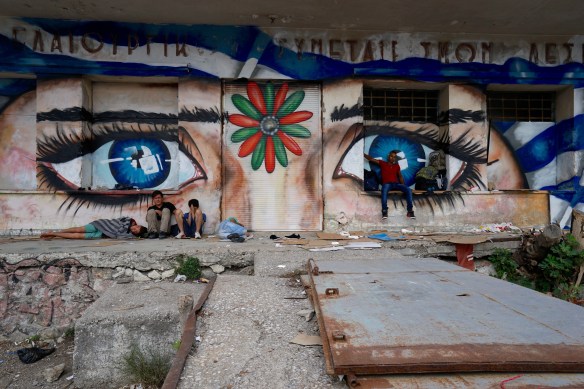
What is a refugee camp like? How are children living and learning there? And is there anything that I can do to support? These questions are still floating through my mind – it would be arrogant and naïve to expect easy answers – but I have at least some frame of reference now. I’ve just returned from Jordan, where I visited two camps. Continue reading
Category Archives: News & conferences
Trauma research must be Open Access
We recently examined how global and how open the literature on Posttraumatic Stress Disorder is.
Not very global, and not very open.
Only 13% of the publications of 2012 regarded samples in low- or middle-income countries and 58% were behind a paywall.
Today I want to talk about the latter, the paywall part.
It worries me that practicing psychologists can’t access the latest research on therapy effectiveness. Or on how to deal with drop-out from clinical interventions. Or on how children experience trauma recovery.
As you may know, the migration crisis and refugees are on my mind a lot these days. I can’t justify, in any way, why a large part of the relevant knowledge is unavailable to support those who are affected.
Not only practitioners have little access to the latest evidence. The same applies to many scholars in low-resource settings, policy makers, and citizens in general.
Much research is behind a paywall, even though it was funded with public money. This system is lucrative for the publishers of certain ‘traditional journals’, which charge extra-ordinary amounts of subscription money to university libraries.
Getting radical
A tornado in my head
“They didn’t even have nappies at the maternity ward,” she tells me
“I had to get my sister out of there: that hospital was a health risk.”
With our feet on the edge of a South-African fireplace, we are having a glass of wine. She is a beautiful woman from Lesotho who has made an impressive journey in life, now finishing her PhD while being an accomplished facilitator.
Twenty minutes ago, she asked me what I exactly try to find out with my research. So I told her about our projects on how parents support their children after a serious injury. About our research on care for children who lost a parent due to fatal domestic violence. And about our recent survey on emergency staff’s education needs regarding child traumatic stress.
She listened with interest, and then she started talking. About her experiences with hospitals in South Africa. Continue reading
Refugees in Europe: A crisis?
Over 1 million people arrived in Europe by sea in 2015. And since the conflict in Syria continues, this influx will not halt.
It is the biggest refugee crisis since World War II according to the UNHCR. The journey by sea is dangerous, the circumstances in refugee camps and asylum seeker centers are far from ideal – to say the least – and tensions between host countries make it difficult to find constructive solutions.
With such big numbers and their political, social and logistical complexities, it’s easy to feel powerless as an individual.
Still, there are opportunities. As Margaret Mead has famously been quoted:
“Never doubt that a small group of thoughtful, committed citizens can change the world. Indeed, it’s the only thing that ever has.”
On (or off?) sabbatical
It has been a bit silent on the blog in the past few months. And it was for a reason; I was on leave! Since some of you have asked me what I have been up to, I thought I’d write a slightly different blogpost this time, and share my experiences of the first half of 2015…
After doing trauma research for about 10 years, I felt that it was time for a break. My plan was to find time to reflect, experiment with new ideas, and learn, rather than simply continue on the research diesel engine (or, some may prefer the metaphor of a continuous sprint…!).
So I took a few months of unpaid leave. Some people said that I was committing career suicide; as an academic you’re expected to publish continuously. Certainly, the past few months have reduced my average output rate. However, I am very happy that I have done it, and I think that in the long run my work will be better for it. So what have I done exactly?
Help set up the Africa Science Leadership Program Continue reading