Highlights of the ISTSS conference in Baltimore

Last week’s conference of the International Society for Traumatic Stress Society was a success. A lively conference with a number of excellent and thought-provoking presentations, where some insights kept on popping up. For me, the highlights of the conference with regard to children and youth all related to interventions:

New, large studies on early interventions

Researchers from Switzerland and Australia presented the outline of large, rigorous studies to measure the effect of early interventions for children who have been accidentally injured. These studies will lead to insights into the effectiveness of a short intervention and a longer one. Continue reading

Parents tell about their children’s recovery from trauma

A child has been injured in an accident. Or has witnessed a suicide. Or has been assaulted on the way home from school. What is parents’ story when such a thing happens? How do they describe the recovery of their child? And what can we learn from their experiences?

We spoke in-depth with the parents of 25 children who had been through varied types of trauma, including serious road traffic accidents, witnessing murder, sexual assault, the loss of a sibling, and an explosion at home. The events had happened at least 6 months previously and the children were between 8 and 12 years old at the time of the interview.

Even though our questions mainly regarded the child’s recovery, parents talked a lot about their own role in this recovery. In particular, they spoke about two elements of their parenting. The first concerned becoming aware of the child’s needs. Parents tried to figure out what would be normal reactions to the event and to what extent their child showed those or more severe reactions. They used various strategies, including: Continue reading

Predictors of PTSD in children and adults

We know that traumatic events occur quite often. We also know that most people are resilient, even though many survivors experience some distress in the direct aftermath of an event. Only a minority will develop longer-term stress symptoms. What are their characteristics? Who is ‘at risk’ after trauma? If we know the answer, we can target mental health care services to the survivors who are most in need.

In the last 30 years, more and more research has been published on predictors of posttraumatic stress. Mainly in adults, but also in children. Continue reading

To ask or not to ask children about trauma, that’s the question

Actually, I don’t think it’s the question. My impression from the research literature, clinicians’ comments, and my own experience is that it is not harmful when we discuss the topic in a respectful, open-minded way. On the contrary, I think it’s very important to ask children about traumatic exposure and posttraumatic stress reactions. But we should prove it. And if I turn out to be wrong, we should know as well. Continue reading

Does it hurt to ask children about trauma? Part II

Last week, I asked the question in two LinkedIn groups, and received over 20 reactions from mental health clinicians. Their answers were very consistent, and contained a couple of main messages:

  • It doesn’t hurt to ask about trauma. These clinicians were more worried about not asking about trauma.
  • It is important to let children talk about their potential traumatic history in their own words and in their own time.
  • Clinicians should make sure that they have the appropriate skills to engage in trauma-related conversations with children. Some of the LinkedIn members saw clinicians being afraid of discussing trauma as an important area for improvement of care.
  • If you are a mental health clinician wanting to learn about discussing traumatic exposure or posttraumatic stress reactions with children and adults, the online trauma focused CBT training is a good start.
  • When asked, many children and youths are remarkably open about their experiences.

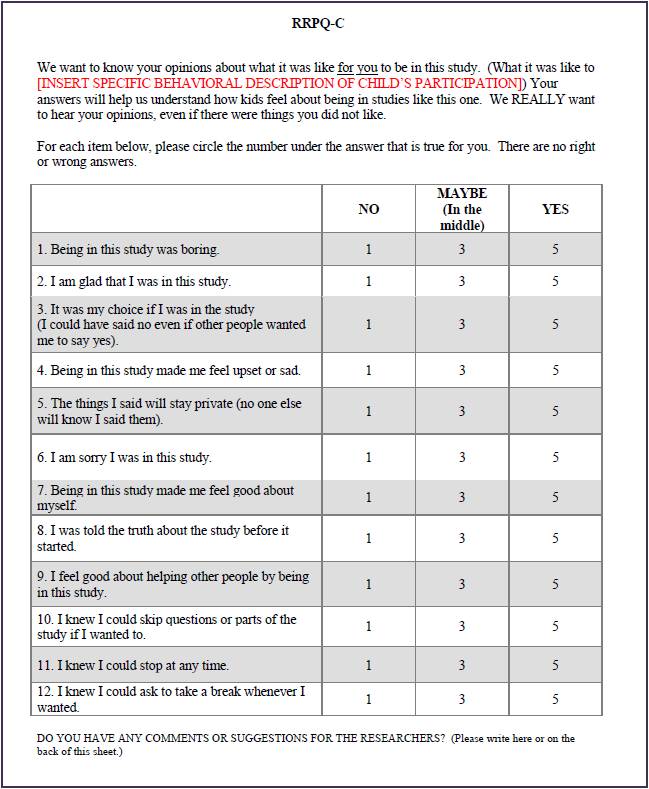
Next time, I will describe the instrument to systematically measure children’s reactions to questions about trauma in research: the Response to Research Participation Questionnaire for Children and Parents (RRPQ-C and RRPQ-P, available in English and Dutch)!