Highlights of the ISTSS conference in Baltimore

Last week’s conference of the International Society for Traumatic Stress Society was a success. A lively conference with a number of excellent and thought-provoking presentations, where some insights kept on popping up. For me, the highlights of the conference with regard to children and youth all related to interventions:

New, large studies on early interventions

Researchers from Switzerland and Australia presented the outline of large, rigorous studies to measure the effect of early interventions for children who have been accidentally injured. These studies will lead to insights into the effectiveness of a short intervention and a longer one. Continue reading

Chance Encounters

Fancy a little gallery visit but it’s too rainy/sunny to go out?

Visit my virtual exhibition (until March 2023)!

Chance Encounters addresses various aspects of social justice, often based on our team’s research over the years. Where possible with a side of humour.

The easiest is to ‘enter exhibition,’ below, click on the text on the wall on your left-hand side and go from there. There are little i-signs that provide more information about each piece.

Chance Encounters

And if it’s of interest:

We recently recorded a seminar for researchers interested in doing more with art. Being interviewed by the fabulous Jonathan O’Donnell of the Research Whisperer, hosted by Jeff Craig and team, was a lot of fun.

SSN Seminar

PhD scholarships at Monash University

There is an interesting opportunity for young trauma researchers: to do a PhD at Monash University (Melbourne, Australia). Monash Injury Research Institute is a multidisciplinary center, doing research on both the prevention and outcome side of trauma, which may lead to creative cross-overs. Particularly interesting for researchers in psychotraumatology are the topics adolescent refugee mental health, child abuse, disaster resilience, and injury outcomes.

For the full text of the advertisement, see below. Beware that the deadline for expressions of interest is 12 October. Continue reading

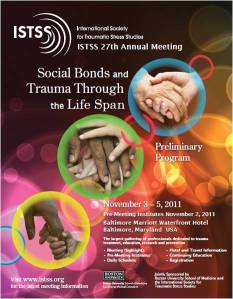
ISTSS conference about trauma

The annual meeting of the International Society for Traumatic Stress Studies is approaching. Early November the Mariott Waterfront Hotel in Baltimore will be crowded with psychologists, social workers, psychiatrists, journalists, policy makers, victim advocates, counselors, and many others. This year’s theme is “Social Bonds and Trauma Through the Life Span”. The meeting may not be in the most beautiful city of the US (although, even Baltimore has its hidden charms), but it looks like there will be quite a number of interesting presentations.

Judith Herman, a pioneer in traumatic stress research, will give a keynote lecture. Her book Trauma and Recovery was probably the only textbook that really touched me during my studies. As always during the ISTSS conferences, there will be an overwhelming amount of research presentations and posters. One that I look forward to regards a meta-analysis on the relation between parent functioning and child posttraumatic stress, by Morris and Delahanty. It will be interesting to hear what they think about the ways parents influence their children; and where we can intervene. Another one that sounds promising is a symposium on challenges and successes in evaluating community-based interventions for children (Jaycox and colleagues). Continue reading

Former bomb disposal operator writes about posttraumatic stress

I just read the book “Extreme risk – A life fighting the bombmakers”. Chris Hunter describes his (training towards the) life as a British bomb disposal operator in it. He served in Bosnia, Northern Ireland, Iraq, and Afghanistan, amongst others. The book is a good read, and clearly shows the psychological effects of the war tragedies Hunter has witnessed. Although apparently he continued to function well enough to work, he did suffer from quite severe symptoms of posttraumatic stress for some time. One of his biggest losses concerned his wife and two daughters; he divorced, at least partly due to his symptoms and subsequent alienation. Three quotes I think were interesting: Continue reading